












Department of Computer Science
Teachers Count
13

Department of Computer Science
Overview
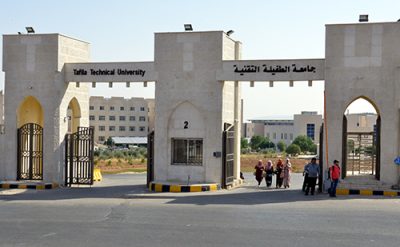
The Computer Science Department at the Faculty of Information and Communication Technology, Tafila Technical University, is an academic entity specializing in contributing to the university’s mission by building a solid knowledge and technical foundation for students. Believing in its pivotal role in advancing technical education, the department continually strives to elevate its academic level to meet global standards, support scientific research, contribute to the knowledge society transition, and prepare qualified graduates who participate in national development and advancement.
At the undergraduate level, the department offers specializations in Cybersecurity and Artificial Intelligence & Data Science. The Cybersecurity program focuses on protecting systems and information from digital threats, while the AI & Data Science program is concerned with data analysis and developing intelligent solutions using the latest technologies. At the diploma level, the department offers a Cybersecurity program designed to equip students with practical skills that meet labor market requirements.
As part of its development plans, the department is working to introduce undergraduate programs in Digital Forensics and the Internet of Things, aligning with modern academic standards and local and regional market needs.
Mission
To provide distinguished quality education in Computer Science, Artificial Intelligence, and Cybersecurity by offering an academic and research environment that integrates theoretical knowledge with practical application; preparing qualified and creative national cadres capable of competing in the labor market, contributing to community service, sustainable development, and digital transformation.
Program Educational Objectives (PEOs)
The department’s academic programs aim to graduate students who can:
- Specialized Knowledge: Understand and apply fundamental and advanced concepts in computer science, mathematics, and statistics, and employ them in AI and Cybersecurity fields.
- Problem Solving and Innovation: Analyze complex computational problems and design innovative, effective, and secure software and technical solutions.
- Professional and Technical Competence: Utilize modern tools, advanced programming languages, and techniques proficiently to meet industry requirements.
- Ethical Responsibility: Adhere to professional ethics, cybersecurity laws, and data privacy standards when developing or using computer systems.
- Teamwork and Lifelong Learning: Work effectively in multidisciplinary teams and demonstrate readiness for continuous self-learning to keep pace with rapid technological changes.
Goals
The Computer Science Department seeks to achieve the following strategic objectives:
- Academic Leadership: Continuously develop and update curricula to keep up with the latest global advancements in computing, AI, and digital security.
- Quality Education: Ensure the application of local and international quality and accreditation standards across all programs offered.
- Scientific Research: Promote a culture of research and innovation among faculty and students, directing research toward solving real-world problems.
- Community Partnership: Build collaboration bridges with industry and tech companies to reduce the gap between academic outcomes and labor market needs.
- Human Resource Development: Attract distinguished academic talents and provide continuous professional development opportunities.
Core Values
- Excellence: Commitment to the highest standards of quality in education, research, and technical development.
- Innovation: Encouraging creative solutions and innovative technical thinking.
- Integrity: Upholding academic honesty and professional ethics.
- Teamwork: Enhancing collaboration among students, academic staff, and the professional community.
- Responsibility: Serving the community and contributing to digital and national development.
Department Majors

1
Credit Hour
Intermediate Diploma
Program Overview
This program prepares technical personnel specialized in cybersecurity, equipped with practical skills to protect networks and systems, detect preliminary threats, and implement digital security policies. It is designed to supply the labor market with qualified technicians capable of working in security operations centers and technical support, efficiently handling daily security challenges.
Key Learning Outcomes
By the end of the program, graduates will be able to:
- Install and manage basic security tools (firewalls, antivirus software).
- Monitor network traffic and detect suspicious or unauthorized activities.
- Apply information security policies, backup procedures, and data recovery processes.
- Provide initial response to security incidents and necessary technical support.
Brief Study Plan Description
The program includes:
- Foundations of Computing: Introduction to IT, basic programming (Python/Scripting), operating systems, computer networks.
- Cybersecurity Core: Principles of cybersecurity, network and wireless security, risk management, introduction to ethical hacking, digital forensics.
- Practical Applications: Vulnerability assessment tools, security incident management. – Training & Capstone Project: Field training at tech institutions and applied diploma project.
- Expected Career Paths Cybersecurity Technician, SOC Analyst (Level 1), Network & Security Support Officer, Systems Protection Supervisor.
1
Credit Hour
Bachelor Degree
Program Overview
The Cybersecurity program focuses on protecting systems, networks, software, and data from digital attacks and increasing cyber threats. It equips students with the skills necessary to detect vulnerabilities, prevent intrusions, apply encryption standards, and ensure the confidentiality, integrity, and availability of information in digital environments.
Key Learning Outcomes
- By the end of the program, graduates will be able to:
- Design and implement security strategies to protect networks and infrastructure.
- Detect and analyze cyber threats and respond effectively to security incidents.
- Conduct ethical penetration testing to assess system vulnerabilities.
- Apply modern encryption techniques and web/application security measures.
- Manage risks and comply with local and international security policies and regulations.
- Choose the appropriate programming language for tasks.
Brief Study Plan Description
- Basic Requirements: Computer networks, operating systems, programming fundamentals, database management.
- Specialization Requirements: Network security, ethical hacking, digital forensics, cryptography, software security, risk and information security management, malware analysis, infrastructure security.
- Supporting Requirements: Cyber laws and regulations, cybersecurity ethics.
- Practical Training & Capstone Project: Field training in security operations centers or cybersecurity companies, applied graduation project in cyber defense.
- Expected Career Paths Cybersecurity Analyst, Ethical Hacker, Network Security Engineer, Digital Forensics Investigator, Incident Response Officer, Information Security Officer.
1
Credit Hour
Bachelor Degree
Program Overview
The Artificial Intelligence & Data Science program aims to prepare specialized professionals capable of building human-like intelligence systems and extracting valuable knowledge from big data. The program integrates mathematical and statistical theories with advanced programming techniques, enabling students to develop machine learning models, natural language processing applications, and data analysis solutions that support strategic decision-making and solve complex problems efficiently.
Key Learning Outcomes
By the end of the program, graduates will be able to:
- Select the appropriate programming language for each task.
- Analyze big data and identify patterns and trends.
- Design and develop AI models and machine learning and deep learning algorithms.
- Apply natural language processing and computer vision techniques in practical solutions.
- Use data visualization tools to clearly present results to decision-makers.
- Handle AI ethics and data privacy responsibly.
Brief Study Plan Description
The curriculum covers the following areas:
– Fundamentals of Computer Science & Programming: Introduction to programming, databases, operating systems, Java programming, Python programming, computer networks.
– Specialization Requirements: Machine learning, deep learning, data mining, natural language processing, computer vision, big data analysis, cloud computing, research skills.
– Practical Training & Capstone Project: Internship at tech companies and a graduation project focusing on solving a real-world problem.
Expected Career Paths
Data Scientist, AI Engineer, Machine Learning Engineer, Data Analyst, Intelligent Systems Developer, AI Researcher.
 العربية
  English