













Chief of the Royal Hashemite Court Inaugurates "Jordan Oasis" at Tafila Technical University
Chief of the Royal Hashemite Court Inaugurates "Jordan Oasis" at Tafila Technical University
TAFILA – August 17, 2026
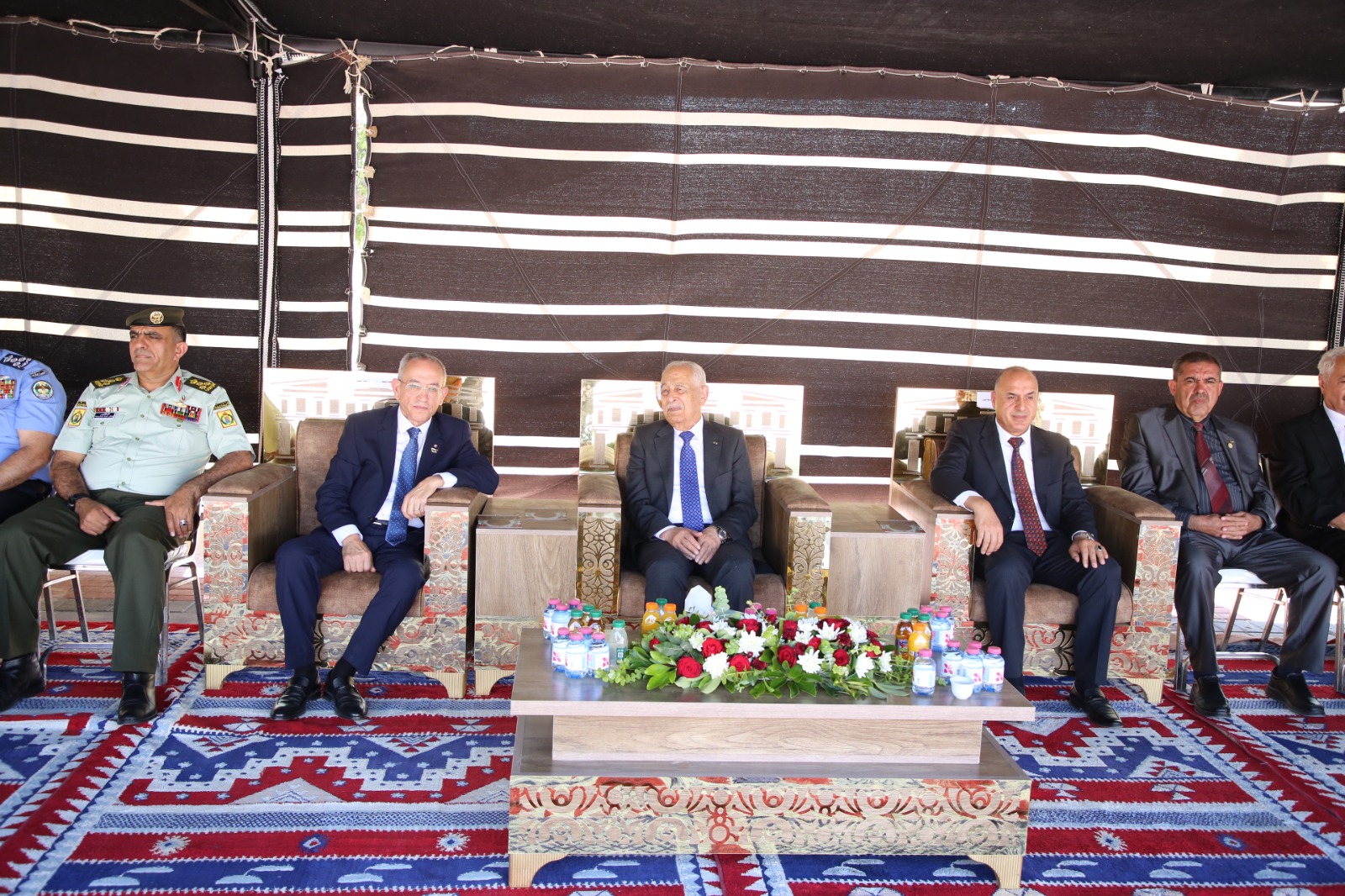
The Chief of the Royal Hashemite Court, Yousef Hassan Al-Issawi, inaugurated today, Monday, the “Jordan Oasis” at Tafila Technical University (TTU). The ceremony was attended by the Governor of Tafila, Dr. Sultan Al-Madi, alongside an array of dignitaries, including current and former cabinet ministers, senators, and MPs, high-ranking military and security officials, local tribal elders, community and media figures, faculty, administrative staff, and students.
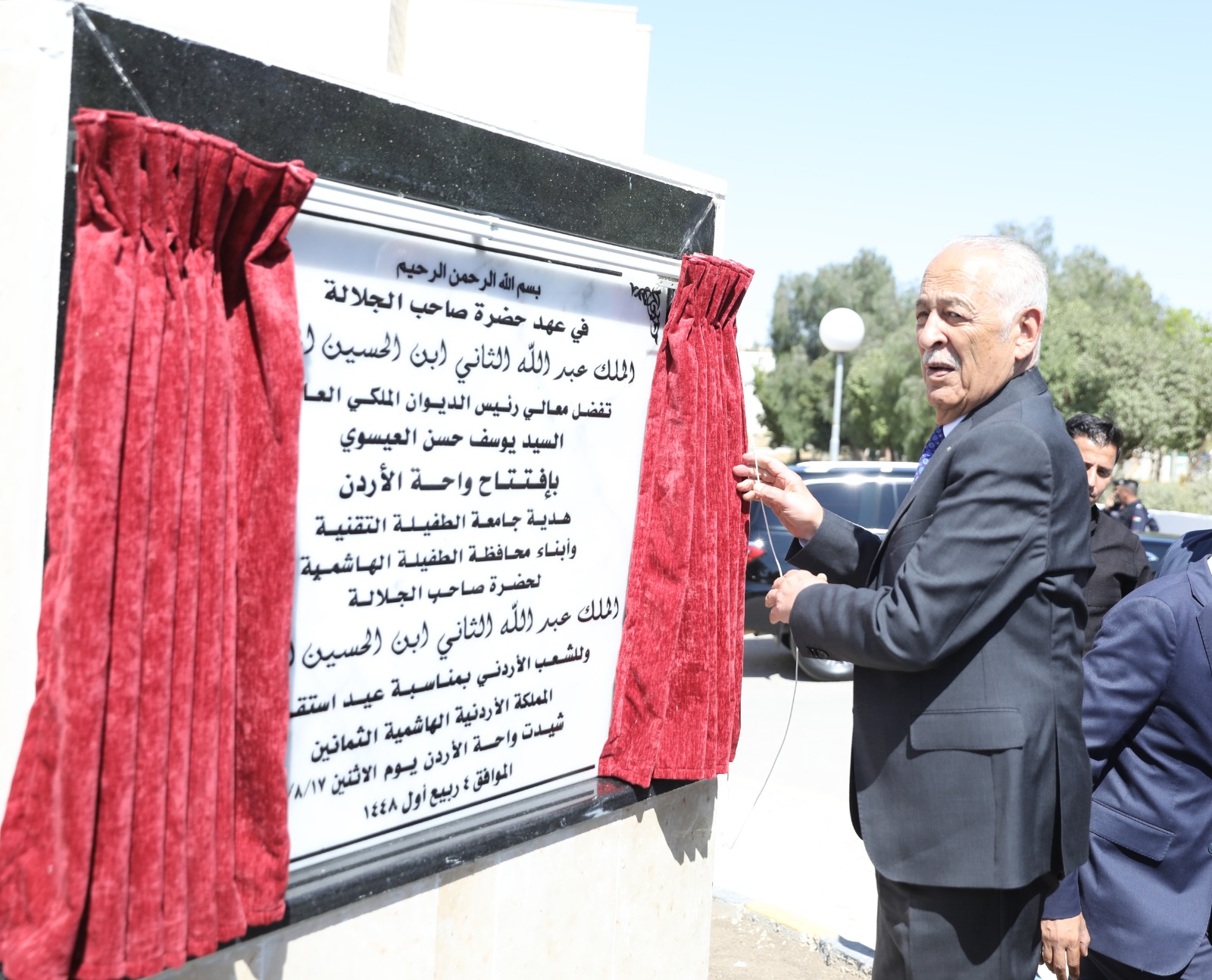
The inauguration commenced with the Chief of the Royal Hashemite Court unveiling the commemorative curtain, followed by the Royal Anthem and a recitation from the Holy Quran.
Al-Issawi toured the Jordan Oasis, receiving a detailed briefing from the university president regarding its symbolism and structural components. Spanning approximately 65 meters in length and 55 meters in width, the oasis stands as a prominent artistic and cultural landmark within the university, designed to enrich the aesthetic and cultural landscape of the academic environment.
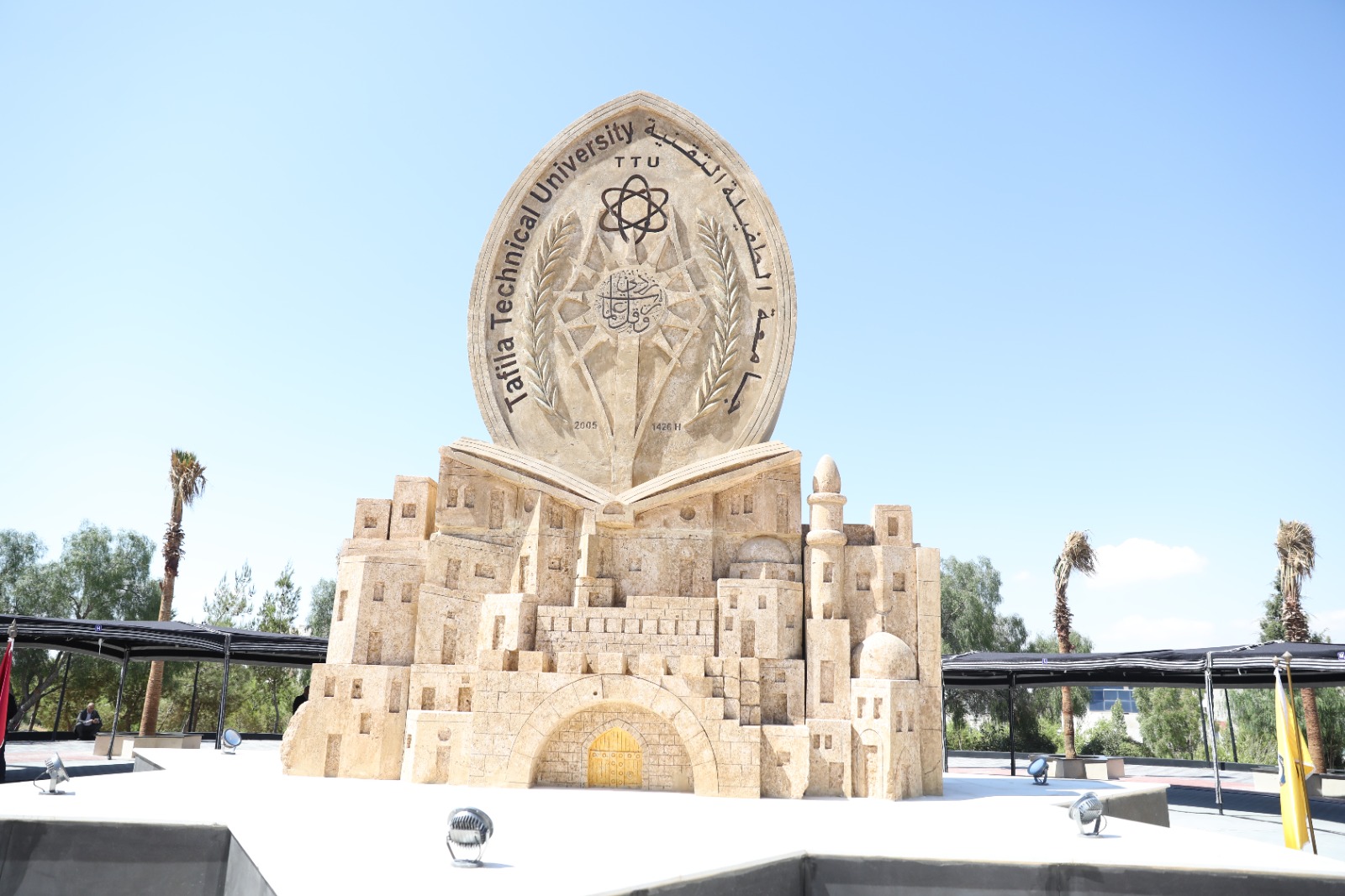
At the heart of the oasis lies a sculptural monument inspired by the historical legacy and civilizational landmarks of the Tafila Governorate, incorporating elements intrinsically linked to the Jordanian national narrative and the Kingdom’s history. The structure comprises three primary sections:
-
The Lower Base: Consists of two distinct tiers. The first is a circular base measuring 12 meters in diameter and 60 centimeters in height, crafted from marble sourced from the Jurf Al-Darawish and Al-Hasa regions, combined with black basalt inlaid with cream Madaba stone. The second tier assumes the shape of a seven-pointed star—symbolizing the star on the Jordanian flag—measuring 10 meters in diameter and 50 centimeters in height.
-
The Middle Section: Features hand-carved stone measuring five meters wide and two and a half meters high. It portrays several archaeological and heritage landmarks of the governorate, including the ancient stone-terraced houses of Tafila, reflecting traditional architecture and the city’s historic essence.
-
The Central Composition: Incorporates an entrance inspired by the Tafila Castle, alongside motifs drawn from the Shrine of Al-Harith bin Umayr Al-Azdi, the Jurf Al-Darawish region, and historical symbols associated with Khirbet At-Tannur, Khirbet Adh-Dharih, and several heritage villages across the governorate.
The reverse facade of the mural features a three-meter-high oval monument, centered with a map of Tafila and a quote by His Majesty King Abdullah II: “My warm greetings to the people of Tafila, the descendants of the ‘Had Al-Daqiq’ [stalwarts of bravery],” topped by the number “80 Years of Independence.” This is accompanied by sculptures depicting the Sharif’s Palace, the Black Iris, the Arabian Oryx, wind power turbines, Khirbet At-Tannur, the Sinai Rosefinch (Jordan’s national bird), and olive branches.
The oasis aims to serve as a cultural and artistic landmark within the campus, reflecting Tafila’s deep-rooted history, reinforcing students’ connection to their local heritage, and imbuing the academic milieu with a distinct aesthetic identity where science, culture, art, and national identity converge.
In his address, TTU President Dr. Al-Shalabi emphasized that inaugurating the “Jordan Oasis” in conjunction with the Kingdom’s 80th Independence Day conveys a national message transcending a mere campus initiative. He noted that the oasis functions as a spatial memory, a testament to human spirit, and a reflection of Jordan—evoking Tafila’s heritage while celebrating national roots and looking ahead with confidence.
Dr. Al-Shalabi stated that convening at TTU, situated in Hashemite Tafila—whose history is etched into its rocks and preserved within its mountains—occurs on a cherished national occasion blending the celebration of Jordanian independence with the unveiling of the oasis.
He added that the oasis is not merely stone, foliage, and water, but a vivid portrait of Tafila’s history, Jordan’s identity, and the future Jordanians are actively constructing. Every stone tells a story, every tree carries meaning, and every detail reassures future generations that those who honor their roots face the future undaunted.
Furthermore, Dr. Al-Shalabi underscored that this milestone was not achieved by a single entity, but through collaborative synergy involving partners and supporters across various sectors, extending his gratitude to national corporations, public and private institutions, and local citizens who helped turn the vision into reality.
He offered special commendation to the TTU community—the engineers who planned, the technicians who executed, the laborers who worked tirelessly, and the administrative staff who oversaw every phase—stating that the final project stands as a testament to their collective dedication.
Dr. Al-Shalabi praised His Royal Highness Crown Prince Al Hussein bin Abdullah II’s unwavering commitment to the youth, emphasizing that Jordanian youth represent the nation’s greatest asset, and that Jordanian universities will remain beacons of knowledge, incubators of innovation, and cradles of excellence.
He highlighted the role of Jordanian youth in prioritizing the nation and elevating Jordan’s prestige across global platforms.
Addressing the media, Dr. Al-Shalabi emphasized that the press transcends routine reporting; it safeguards national memory and drives impactful narratives. The presence of media figures underscores the vital role of broadcasting Jordanian achievements to the world, noting that Tafila harbors stories and accomplishments well worthy of global coverage.
He concluded that celebrating independence from Tafila represents a commitment to driving national progress through education, youth empowerment, and unity, dedicating this achievement on behalf of the governorate and university as a tribute to His Majesty King Abdullah II and His Royal Highness Crown Prince Al Hussein.
For his part, the Director General of the Media Commission, Basheer Al-Momani, stressed the importance of embedding the Kingdom’s governorates at the core of the national media narrative, moving beyond conventional news reporting toward presenting a comprehensive profile of their civilizational, tourism, archaeological, and investment potential.
Al-Momani remarked that the journey of the Jordanian state represents a collective national project built by its citizens across all sectors, noting that Hashemite Tafila stands as an enduring witness to its people’s contributions to state-building.
He expressed appreciation for TTU’s pioneering role as an academic and developmental institution, commending its leadership for fostering community engagement and enhancing Tafila’s role in national progress.
Al-Momani affirmed the Media Commission’s commitment to ensuring all governorates receive their rightful visibility on the national media map, highlighting their intrinsic beauty, investment opportunities, and heritage.
The ceremony featured a display by the Royal Desert Patrol (Hajjana) falconers, alongside musical performances by the Jordan Armed Forces Band, reflecting the governorate’s rich cultural diversity.
At the conclusion of the event, the university honored the supporting organizations, with Al-Issawi presenting commemorative shields to their representatives.
The university also honored the Chief of the Royal Hashemite Court, with Dr. Al-Shalabi presenting him with a shield of appreciation for his continuous support of national initiatives.
In coordination with the Media Commission, the event saw international media representation, including journalists from Algeria and Lebanon working for global news outlets.
The major supporting entities for the project included the Arab Potash Company, Jordan Phosphate Mines Company, Greater Amman Municipality, Cairo Amman Bank, and businessman Ziad Al-Manaseer.
Event Highlights in Photos
Community Relations & Communications